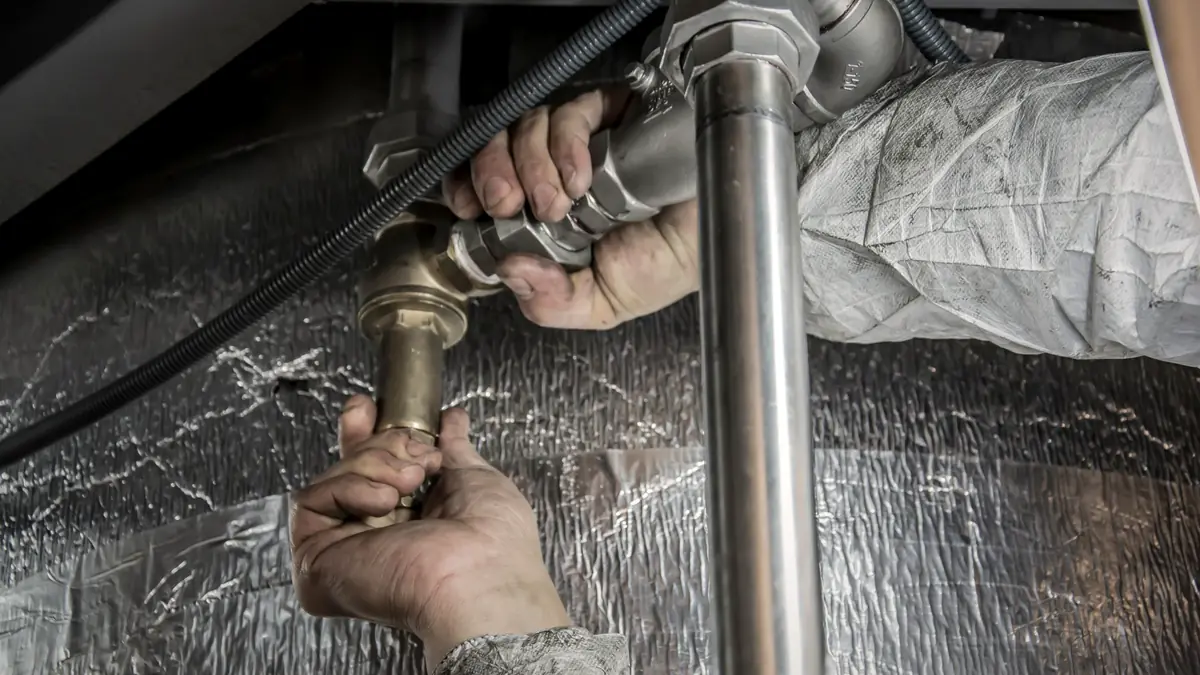
Fixing a leaking water heater starts with shutting off the power and the water supply, then tracing the leak to its source before deciding whether to repair or replace the unit. A loose connection or a faulty drain valve or temperature and pressure relief valve can be tightened or swapped out, but a rusted tank leaking from the bottom cannot be sealed and needs replacement. Standing water from the leak still soaks nearby flooring and drywall within hours, so drying the area matters as much as stopping the leak itself.
What Should You Do First When a Water Heater Is Leaking?
To stop a leaking water heater, you cut the power and close the cold water supply before touching anything else. The first steps when a water heater leaks are a short safety sequence that limits how far the water spreads into flooring and drywall. Working in order keeps a live heating element or gas burner away from water while the source is still unknown.
- Turn off the circuit breaker for an electric unit, or set the gas control knob to Pilot on a gas unit.
- Close the cold water shut-off valve on the water supply line entering the top of the tank.
- Move boxes, laundry and valuables away from the standing water.
- Soak up pooled water with towels and note how fast it returns.
These steps stop the flow before any repair work begins and keep the water from reaching more of the room. On an electric unit, cutting the breaker removes any shock risk before a hand goes near the wet tank; on a gas unit, turning the control to Pilot leaves the pilot light undisturbed while stopping the burner. How quickly the water returns after towelling also hints at the leak size, which guides the repair-or-replace decision later. Wet drywall, carpet and subfloor should be dried within 24-48 hours to limit mold growth (EPA, 2024), so a fast shut-off in a Kent, WA garage or utility closet protects the room as much as the heater.
How Do You Find Where a Water Heater Is Leaking From?
To find where a water heater is leaking, you trace the water back to its highest wet point on the unit. Water runs downward, so the true source sits at or above the highest spot where the metal is wet, not where the puddle collects. Drying the outside of the tank with a towel and watching where moisture reappears first narrows the leak to one of four points. Checking the pipe connections at the top, the temperature and pressure relief valve on the side, and the drain valve at the base in that order isolates the source before any tool comes out.
| Leak point | What it looks like | Likely cause | Repairable? |
|---|---|---|---|
| Connections or pipes at the top | A drip at the cold or hot water fittings | A loose or corroded connection | Yes |
| Temperature and pressure relief valve | Water from the discharge pipe | Excess pressure or a failed valve | Yes |
| Drain valve at the base | A slow drip from the spigot | A worn washer or a loose valve | Yes |
| Bottom of the tank | A puddle under the unit with no fitting above it | Internal tank corrosion | No, replace |
The top three points are hardware threaded onto the tank, so each one can be tightened or swapped without opening the tank itself. A leak at a hot fitting often leaves a mineral crust where water has evaporated, while a cold-side drip stays clear. A drip pan beneath the heater catches a minor fitting leak and sends it to a floor drain, which can mask a slow drip until the pan overflows. Condensation on the tank during a cold Kent, WA morning can also mimic a leak, so a surface that dries and stays dry after towelling is not a true leak. A wet tank bottom with nothing leaking above it points to the steel wall itself, which no fitting repair can reach.
How Do You Repair a Leaking Water Heater Valve or Connection?
To repair a leaking water heater valve or connection, you isolate that part, drain enough water to reach it, and tighten or replace it. The repairs a homeowner can make are limited to the fittings and valves outside the tank, never the tank wall. Each repair starts by closing the cold water shut-off valve and relieving pressure through an open hot tap so water does not spray when the fitting loosens.
- Tighten a loose pipe connection with a wrench, without overtightening and stripping the thread.
- Replace a dripping drain valve after draining the tank below the valve first.
- Swap out a failed temperature and pressure relief valve once the water pressure reads within the range printed on the manufacturer label.
- Flush sediment through the drain valve if the drip comes from a valve that will not seat.
Overtightening is the common mistake, since forcing a fitting past snug damages the threads and starts a new leak. Draining through a garden hose attached to the drain valve sends the water to a floor drain or outside rather than across the floor. Sediment buildup is often the reason a drain valve will not reseal, so flushing it clears the grit before a new washer goes in. The manufacturer label on the tank lists the rated temperature and water pressure, and matching a replacement relief valve to those figures keeps the new part within spec. Once these fixes hold, the next question is whether the leak was ever repairable, or whether the tank itself has failed.
When Is a Leaking Water Heater Repairable, and When Does It Need Replacing?
The key difference between a repairable water heater leak and one that needs replacement is whether the tank itself is leaking. A leak from a fitting, a valve or a connection is a repair, because the failed part can be swapped for a few dollars. A leak from the bottom of the tank is a replacement, because a glass-lined tank cannot be resealed once internal corrosion eats through the steel wall.
| Situation | Repair or replace | Why |
|---|---|---|
| Loose fitting or connection | Repair | The seal, not the tank, has failed |
| Faulty drain or relief valve | Repair | The valve is a replaceable part |
| Tank corroded, leaking from the base | Replace | A glass-lined steel tank cannot be resealed |
| Unit over 10-12 years old with a base leak | Replace | Age plus tank corrosion rarely justifies repair |
A valve or connection part runs $15-$50 in most homes, while a full tank and installation reaches the four-figure range, so the leak point drives the cost far more than the labour does. Age is the second factor: a base leak on a unit past 10-12 years rarely justifies a repair, since the rest of the tank sits on the same corrosion clock. Replacing a tank means draining the unit fully, disconnecting the water supply line and the gas or electrical feed, and setting a new tank, which is why the labour outweighs a simple valve swap. Left in place, a base leak widens as corrosion spreads, so the puddle that appears today grows each week until the tank is replaced. The build date prints on a label near the serial number, and what a water heater leak repair costs breaks the valve, tank and water-damage figures down further.
Can You Fix a Leaking Water Heater Yourself, or Does It Need a Pro?
Yes, you can fix a leaking water heater yourself when the leak is at a valve or connection, but a leaking tank and the water damage it leaves behind need a professional. The jobs that call for a professional are the ones involving the tank, the utilities feeding it, or water that has already soaked building materials.
- A tank leaking from the bottom.
- Gas-line or electrical connections near the unit.
- Standing water that has soaked carpet, drywall or a subfloor.
- A leak that keeps returning after a valve replacement.
Each of these carries a risk a wrench cannot fix, from a live gas connection to a saturated subfloor that keeps feeding moisture into a wall. A leak caught at the valve stage rarely reaches the subfloor, while a tank failure can release the tank’s full volume onto the floor at once. Once water reaches flooring and drywall, the problem shifts from plumbing to drying, and the 24-48 hour window from the shut-off step still applies. In the Puget Sound climate, trapped moisture under flooring feeds mold within that same window, so drying the structure matters as much as the plumbing fix. A local water damage restoration company extracts the standing water and dries the structure to the moisture targets in IICRC S500, the standard restoration companies follow. For a leak that has already wet the floor of a Kent, WA home, water heater leak cleanup in Kent, WA covers the extraction and structural drying a tank failure leaves behind.
What Causes a Water Heater to Start Leaking?
A water heater starts leaking because a valve fails, a connection loosens, or the tank corrodes from the inside. Sediment buildup at the base, a depleted anode rod, excess water pressure, and simple age are the forces behind those failures. Minerals settle to the bottom of the tank and trap heat against the steel, while the sacrificial anode rod that protects the tank wall slowly wears out and lets tank corrosion take hold. Water pressure above the range stamped on the tank also strains the relief valve, which opens to release the excess and can drip as a result.
Each cause points to a different leak point, which is why the source determines whether the leak is repairable. A pressure fault or a worn valve is fixable, but internal corrosion is the failure that ends the tank. The full breakdown of what causes water heater leaks explains where a tank leaks from and why the bottom gives out first.
Frequently Asked Questions About a Leaking Water Heater
Can a Water Heater Be Fixed if It's Leaking?
Yes, a leaking water heater can be fixed when the leak comes from a valve, a fitting or a connection. The one exception is the tank itself: a tank leaking from the base is corroded and is replaced, not repaired. Tightening a pipe connection or swapping a drain or relief valve restores the unit, while a rusted-through tank cannot be sealed.
Why Is My Hot Water Heater Leaking From Underneath?
A water heater leaks from underneath because either the drain valve is dripping or the steel tank has corroded through. A drain-valve leak traces to the spigot at the base and is repairable, while a tank leak shows as a puddle under the unit with no wet fitting above it and means replacement. Either way, water pooling under the heater still damages the floor and subfloor below it.
How Long Will a Water Heater Last Once It Starts Leaking?
Once a tank starts leaking, a water heater can fail within days, because tank corrosion only worsens as water keeps passing through the breach. A valve leak is not on the same clock, since the unit can keep running after the valve is tightened or replaced. A leak from the base is a signal to plan for replacement rather than wait for the tank to open up further.
Is It Safe to Leave a Leaking Water Heater On?
No, it is not safe to leave a leaking water heater on, because a leak can expose the heating element or gas burner to water and raise electrical or scalding risks. Shutting off the circuit breaker or gas control and closing the cold water shut-off valve removes those hazards (CPSC, 2024). A unit left running while leaking also keeps feeding hot water onto the floor, widening the water damage.