To fix water damage in a basement or crawl space, you extract the standing water, strip out soaked materials, then dry the space completely before any repair begins. Safety comes first: shut off the power from a dry spot and leave if you smell gas, because a flooded lower level can carry live current. Speed decides the outcome in Kent, WA, where Puget Sound humidity lets mold take hold within 24 to 48 hours (EPA, 2024). Anything past a small clean-water spill is work for a licensed restoration company, not a mop and a bucket.
What Should You Do First When a Basement Floods?
The first thing to do when a basement floods is shut off the electricity from a dry location, then leave the house if you smell gas.
The safety steps before touching the water are, in order:
- Shut off the main-panel electricity from a dry spot.
- Avoid standing water near outlets, cords, or the furnace.
- Leave the house if a gas odor is present.
- Photograph the water and damage for the insurer.
- Stop the source by closing the main water valve.
Only after the power is off and the source is stopped is removing water safe. In Kent, WA, where West Hill crawl spaces fill fast in heavy rain, use a gas-powered pump off the house electrical system (NDSU Extension, 2023).
How Do You Fix Water Damage in a Basement or Crawl Space?
To fix water damage in a basement or crawl space, you work through five stages: extract, remove, dry, disinfect, and repair.
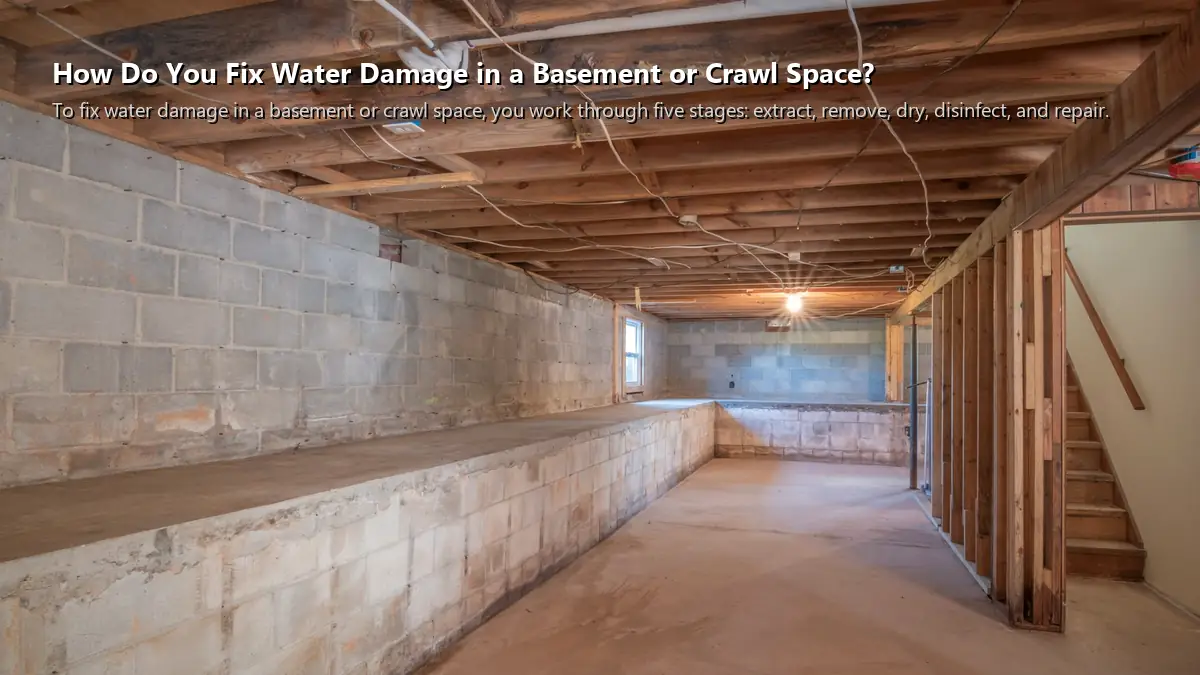
The five stages of fixing basement water damage are:
- Extract the standing water with a pump and wet-dry vacuum.
- Remove soaked drywall, insulation, carpet, and crawl space vapor barrier.
- Dry the structure with air movers and dehumidifiers until moisture-meter readings normalize.
- Disinfect surfaces to stop mold and bacteria.
- Repair and rebuild the materials the water ruined.
Each stage must finish before the next, because repairing over a wet cavity traps moisture and feeds mold. The EPA sets a 24 to 48 hour drying window before mold starts (EPA, 2024), and IICRC S500 is the standard restoration companies follow in Kent’s damp Puget Sound crawl spaces.
What Removes Standing Water Fast?
The fastest tools for removing standing water are a submersible or gas-powered pump for deep water and a wet-dry vacuum for the last inch.
The tools that pull water out of a basement, from deepest to shallowest, are:
- A submersible or gas-powered pump for water over an inch deep.
- A wet-dry (shop) vacuum for the final inch on the floor.
- Fans and air movers to move air across wet surfaces.
- A dehumidifier to pull moisture from air and framing.
- Absorbent cloths or a squeegee for the final film.
Pumps and vacuums clear the water, but only air movers and a dehumidifier finish the drying. Near wiring, use a gas-powered pump, not house wiring (NDSU Extension, 2023).
How Much Does Basement Water Damage Repair Cost?
Basement water damage repair runs $2,000-$10,000 in most homes, with the final figure set by the water category and how far it spread. Grey or black water soaking drywall, insulation, flooring, and crawl space vapor barrier or framing pushes the number up. No price is set without an on-site inspection.
Can You Handle the Cleanup Yourself, or Call a Pro?
Yes, you can handle a small, clean-water spill yourself, but grey or black water and anything that soaked drywall, insulation, or a crawl space needs a licensed restoration company. Standing water over an inch, water in wall cavities or a crawl space, any Category 2 or 3 water, or water near wiring moves to professionals. Washington requires contractors to register with Labor & Industries (RCW 18.27, 2023), so a hired company should hold current registration.
Is the Damage in Your Crawl Space Water or Termites?
The key difference between water damage and termite damage in a crawl space is that water rots wood evenly and darkens it, while dampwood termites hollow the wood along the grain. Pacific Northwest crawl spaces that stay damp attract dampwood termites (WSU Extension, 2022), so standing moisture can mean two problems. Before any repair, confirm which you are fixing: telling crawl space water rot from termite damage, then crawl space water damage repair in Kent, WA.
Frequently Asked Questions About Fixing Basement Water Damage
Will insurance cover basement water damage?
Sometimes: a sudden, accidental leak such as a burst pipe is usually covered, but gradual seepage and groundwater flooding are usually excluded. Surface and groundwater flooding needs separate flood coverage, not a base homeowners policy (Washington Office of the Insurance Commissioner, 2024; III, 2024).
Who do you call for water in a basement?
For water already inside a basement, you call a licensed water damage restoration company, not a plumber, once the leak is stopped. A plumber fixes the source, while a restoration company extracts the water, dries the structure, and rebuilds what the water ruined.
Why is water coming up through the basement floor with no rain?
Water comes up through a basement floor with no rain because a rising water table or a failed sump pump forces groundwater through floor cracks and the floor-wall joint. Kent's high Green River Valley water table raises hydrostatic pressure under the slab.
How much water in a basement is too much?
Any standing water in a basement is too much because even an inch soaks drywall, wiring, and framing and can start mold within 24 to 48 hours (EPA, 2024). Depth matters less than contact time and what the water touches.