Water damage can cause mold, but only when moisture stays in a material past 24 to 48 hours without fast drying. Mold needs moisture, organic material, warmth, and time, and of those four conditions only moisture can be pulled out quickly. Porous materials such as drywall, carpet pad, and insulation grow mold fastest, often inside wall cavities and crawl spaces before any stain shows on the surface. Whether mold takes hold in a Kent, WA home depends less on the leak itself and more on how fast the structure is dried out.
Does Water Damage Always Lead to Mold?
Water damage does not always lead to mold, but the risk is high whenever moisture is left in a material past 24 to 48 hours. Standing water starts the clock the moment it touches drywall, wood, or carpet. The U.S. Environmental Protection Agency states that drying wet or damp materials within 24 to 48 hours prevents most mold from growing (EPA, 2024).
A quick spill on a sealed tile floor that dries the same afternoon rarely develops mold. The same water trapped under laminate, behind a baseboard, or inside a wall cavity can seed a colony within days. The difference is not the amount of water but the time it sits against an organic surface.
A local water damage restoration company measures moisture inside materials, not only on the visible surface, to confirm whether the drying window was met. Homeowners who remove standing water early and keep air moving give mold the fewest openings to develop.
How Long After Water Damage Does Mold Start to Grow?
Mold can start to grow within 24 to 48 hours of a material staying wet, and it becomes established within 3 to 7 days. The exact speed depends on temperature, how porous the surface is, and how much moisture remains after the first response. Warm, damp, enclosed spaces move fastest, which is why hidden pockets outrun the visible floor.
The mold growth timeline after water damage breaks into four stages:
| Time After Leak | What Is Happening | Mold Risk |
|---|---|---|
| 0-24 hours | Materials saturate and absorb water; spores stay dormant | Low but rising |
| 24-48 hours | Early mold development begins on damp organic surfaces | Moderate |
| After 48 hours | Colonies establish on porous surfaces like drywall and carpet pad | High |
| 3-7 days and beyond | Visible growth spreads and releases more airborne spores | Severe |
Each hour of delayed drying moves a wet Kent, WA home further down this timeline. The EPA’s 24 to 48 hour figure marks the window where fast drying still prevents most growth, not the point where mold becomes unavoidable.
What Does Mold Need to Grow After a Leak?
The four things mold needs to grow after a leak are moisture, organic material, warmth, and time. All four already exist inside most homes, so a single leak supplies the one variable that is usually missing. The four growth conditions after water damage are:
- Moisture: from unremoved water or high indoor humidity
- Organic material: drywall paper, wood framing, carpet, and insulation
- Warmth: normal Kent, WA indoor temperatures of 60 to 80F
- Time: as little as 24 to 48 hours of continuous dampness
Of these four conditions, moisture is the only one a homeowner can remove quickly, which is why drying speed decides the outcome. The EPA identifies moisture control as the single most effective way to limit indoor mold (EPA, 2024). Spores are already present in the air and settle on porous materials, so eliminating dampness, not sterilizing the house, is the realistic goal.
Why Does Drying Speed Decide Whether Mold Grows?
Drying speed decides whether mold grows because moisture is the only one of mold’s four requirements that can be removed fast enough to stop it. A home cannot be stripped of organic material, kept below mold-friendly temperatures, or paused in time, so the entire defense rests on pulling water out before spores establish. The faster the moisture leaves, the shorter the window mold has to colonize a surface.
Professional structural drying uses air movers to push moisture off surfaces and dehumidifiers to pull that water vapor out of the air. This forced evaporation reaches moisture deep inside drywall and framing that will not air-dry on its own. Restoration crews follow the IICRC S500 standard, the standard water damage restoration companies follow for measuring and documenting the drying process.
Puget Sound’s damp climate works against natural drying, since high ambient humidity slows evaporation across much of the year. A wet material that might air-dry in an arid state can stay damp for days here. That is why equipment-based structural drying in Kent, WA matters more in this region than in a dry climate.
Which Materials Grow Mold Fastest in a Wet Kent Home?
The materials that grow mold fastest in a wet home are porous ones – drywall, carpet pad, and insulation – because they hold moisture deep where air cannot reach. Non-porous surfaces shed water and dry on their own, while porous ones act like sponges that keep organic food and moisture pressed together. The materials most at risk after a leak compare as follows:
| Material | Porous or Non-Porous | Mold Speed | Can It Be Dried or Must It Be Removed |
|---|---|---|---|
| Drywall | Porous | Fast | Dried if caught early, cut out if saturated |
| Carpet pad | Porous | Fast | Usually removed |
| Wood framing | Semi-porous | Moderate | Dried and monitored with moisture meters |
| Concrete / crawl space slab | Non-porous surface, porous debris on top | Slow on the slab itself | Surface dried, debris cleared |
A saturated carpet pad holds water against the subfloor long after the carpet above it feels dry to the touch. High-humidity rooms such as bathrooms add constant moisture, so porous trim and drywall near a tub or shower stay at elevated risk even without a single large leak.
Where Does Hidden Mold Grow After Water Damage?
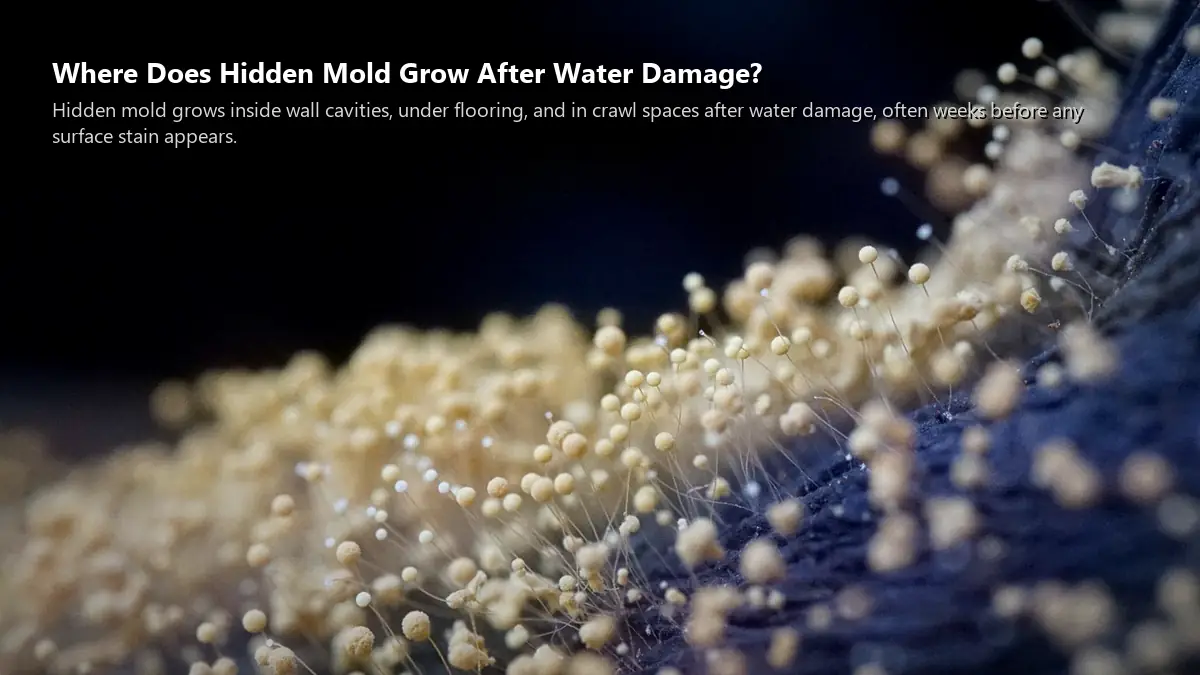
Hidden mold grows inside wall cavities, under flooring, and in crawl spaces after water damage, often weeks before any surface stain appears. Water follows gravity and wicks into enclosed spaces that look untouched from the room. The most common hidden mold locations after a leak are:
- Behind drywall and baseboards where water wicks upward
- Under carpet and the pad beneath it
- Inside the subfloor and crawl space framing
- Within HVAC ducts and insulation
Most Kent, WA homes sit over crawl spaces, so the structure beneath the floor needs to be checked after a leak, not just the visible room. A crawl space traps moisture and air out of sight, which lets crawl space water damage feed mold long before a homeowner notices a musty odor upstairs. Opening wall cavities and inspecting the subfloor is the only reliable way to confirm whether hidden materials dried.
Water Damage or Mold Damage: How Do You Tell Them Apart Before Drying?
The key difference between water damage and mold damage is that water damage is the wet condition while mold is the living growth that follows it if drying is delayed. Water damage shows as staining, swelling, or dampness, while mold shows as spreading discoloration with a musty smell. Knowing which one is present changes whether a material can simply be dried or has to be removed, so the distinction matters before any drying decisions are made. The full comparison, including how each one looks and what each means for repair, is covered in how to tell water damage from mold damage.
Frequently Asked Questions About Water Damage and Mold
How do you get rid of mold caused by water damage?
To get rid of mold caused by water damage, you dry the source completely first, then remove and replace the affected porous materials rather than painting over them. The EPA notes that a homeowner can often clean mold on hard surfaces under about 10 square feet, while larger areas call for a professional (EPA, 2024). Sealing or painting over mold without removing the growth and fixing the moisture only hides it. For larger growth, a local water damage restoration company can assess the extent before removal begins.
How do you tell if you have mold after water damage?
To tell if you have mold after water damage, you look for a musty smell, discoloration, and worsening damp spots even where the surface looks dry. The signs of mold after a leak include:
- A persistent musty or earthy odor
- Fuzzy or discolored patches on walls or trim
- Peeling paint or bubbling drywall
- Returning allergy-like symptoms indoors
The CDC lists a musty smell and visible growth as the clearest indoor mold indicators (CDC, 2024). A lingering odor often signals mold inside a wall or floor you cannot see, so compare it with what water damage smells like.
What are the first signs of mold sickness?
The first signs commonly associated with mold exposure are nasal congestion, coughing, eye irritation, and worsened asthma symptoms, according to the CDC (CDC, 2024). Reactions vary from person to person, and some people have no symptoms at all. Anyone with ongoing health concerns after a water leak should consult a medical professional rather than self-diagnose.
Is black mold from water damage dangerous?
Yes, black mold from water damage can be dangerous enough to warrant removal, though the CDC notes all indoor mold should be treated and removed regardless of color (CDC, 2024). No reliable way exists to tell mold type by sight alone, so color is not a safe measure of risk. The practical response is the same for any color: fix the moisture and remove the growth.
Can water damage cause mold on concrete?
Yes, water damage can cause mold on concrete, though the growth lives on the dust, paint, and organic debris coating the surface rather than in the concrete itself. Concrete is non-porous enough to resist mold internally, but a damp slab in a Kent, WA crawl space or garage keeps feeding surface mold until the area is dried. Clearing the debris and drying the slab stops the growth, a point covered further in water damage on concrete.